
Ground Granulated Blast Furnace Slag (GGBFS) has become a key ingredient in modern concrete, especially in paving work that calls for strength, durability, and long-term performance.
Now that transportation agencies and contractors are looking for materials that support both structural reliability and sustainability goals, GGBFS keeps gaining traction across roadway and infrastructure applications.
Below is a closer look at what GGBFS is, how it’s created, and why it’s used so often in paving projects today.
What Is Granulated Blast Furnace Slag?
Granulated blast furnace slag is a byproduct from the iron-making industry.
During the production of molten iron, impurities separate and form a non-metallic molten material known as slag. When this material is rapidly cooled, typically with water, it turns into a glassy, granular product known as granulated blast furnace slag.
When this granulated slag is dried and ground into a fine powder, it becomes Ground Granulated Blast Furnace Slag (GGBFS), which is sometimes referred to as slag cement. In its powdered form, it takes on cementitious properties similar to ordinary Portland cement (OPC). This allows it to serve as a partial replacement for OPC in concrete mixes.
In addition, slag cement consists primarily of silica and calcium, which contribute to its ability to hydrate and form strong cementitious bonds. Because the base material is a recovered industrial byproduct, it also aligns with sustainability goals and resource-reuse initiatives, setting it up to be a key player in the future of concrete work.
How GGBFS Reacts in Concrete
GGBFS is considered a latent hydraulic material. This means it reacts more slowly than traditional Portland cement but eventually contributes to long-term strength and durability. When substituted for a portion of OPC, often at 30% to 50% replacement levels, GGBFS affects the rate and pattern of strength development.
This study, conducted by faculty members in the Department of Civil and Environmental Engineering at the University of Wisconsin-Madison, explains that mixes containing slag cement show lower early-age strength compared to OPC-only concrete, equal or higher strength by about 14 days, depending on replacement level, and strong long-term performance, especially in pavement environments. This slower early reaction is one of the defining characteristics of GGBFS, and it plays a key role in planning schedules for highway openings, curing, and load-bearing timelines.
What Are the Types of Slag Used in Concrete
When discussing slag in blast furnace operations and its use in concrete, the three most common slag types are:
- Air-Cooled Slag
Slowly cooled slag that solidifies into a crystalline, rock-like material. It is often used as aggregate but not as a cement replacement. - Expanded or Foamed Slag
Produced with controlled air injection, resulting in a lightweight, porous product used in some lightweight aggregates. - Granulated Blast Furnace Slag (GBFS)
Rapidly cooled to form a glassy, sand-like product that is suitable for grinding into GGBFS.
Of these slag types, only granulated blast furnace slag can be ground to create the GGBFS used in concrete mixtures.
Why GGBFS Is Used in Paving Projects
Concrete pavements demand strength, freeze-thaw resistance, and long-term performance. The Wisconsin Highway Blast Furnace Slag Study linked above provides valuable data explaining how GGBFS performs when exposed to real-world highway conditions and stresses.
Here is what you should know about this material’s use in paving:
Improved Long-Term Strength
Although early strength gain is slower, GGBFS-concrete eventually meets or exceeds the strength of mixes containing only Portland cement. In the study, 30% GGBFS mixes reached opening strength roughly 1–2 days later than OPC, while 50% GGBFS mixes needed around 3–4 days longer. After 14 days, both slag-cement mixes equaled or surpassed OPC-only concrete in strength. This predictable strength profile helps contractors schedule highway openings with confidence.
Better Durability Against Scaling and Freeze-Thaw Cycles
Pavement concrete is constantly exposed to freeze-thaw cycles and deicing chemicals. GGBFS mixtures show strong long-term resistance, with the study noting that durability varies depending on slag replacement percentage, curing method, concrete temperature during placement, and Portland cement source. All slag-cement mixes tested fell within acceptable durability limits, even at higher replacement levels.
Reduced Carbonation When Properly Cured
Concrete containing GGBFS can be more sensitive to carbonation during curing. The research found that curing methods that limited carbonation produced the highest level of surface durability. Air-cured samples sometimes performed better than those cured with commercial compounds, depending on the mix.
Sustainable and Environmentally Friendly
The base granulated blast furnace slag is a recovered industrial byproduct. Using GGBFS in pavement concrete reduces the demand for Portland cement, supports recycled material initiatives, and lowers embodied carbon in construction projects. This combination of performance and sustainability is a key reason agencies continue to adopt GGBFS for pavement work.
How Ground Granulated Blast Furnace Slag Is Used in Concrete Mixes
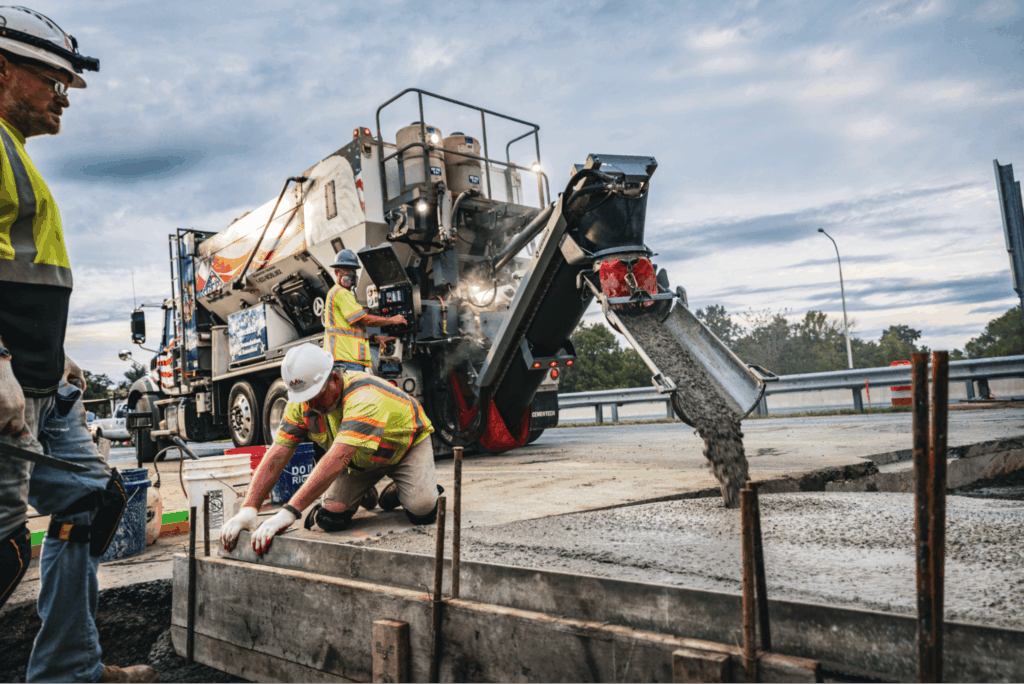
In paving applications, GGBFS is typically substituted for OPC at 30% to 50% by mass, although specific ratios depend on construction project requirements. Contractors often choose GGBFS-enhanced concrete for highway pavements, bridge decks, industrial slabs, flatwork needing improved durability, and projects requiring reduced permeability.
During placement, crews must account for the slightly slower early strength gain, especially in colder temperatures. The Wisconsin study found that at 40°F, slag-cement mixes showed a more pronounced delay in strength development, making temperature control and curing practices especially important.
What Contractors Should Know Before Using GGBFS
When planning to incorporate ground granulated blast furnace slag in concrete paving, consider these factors:
- Curing is critical. Proper curing improves scaling resistance and helps ensure the mix reaches its performance potential.
- Slower early strength is expected. Plan for an extra 1–4 days of cure time before opening to traffic, depending on replacement level.
- Long-term benefits outweigh early delays. Slag mixes can surpass OPC-only mixes in strength after the first couple of weeks.
- Material variations matter. Differences in slag sources, Portland cement sources, and aggregate types can influence performance. Consistent testing helps verify results.
Working with a ready-mix supplier experienced in slag-cement behavior, like GFP Mobile Mix Supply, helps you make sure your mix design is ideal for the project conditions and performance expectations.
A Proven Advantage in Paving
Ground granulated blast furnace offers performance and environmental advantages that make it one of the most valuable materials in the industry.
Research continues to show that with proper curing and the right replacement levels, slag-enhanced concrete supports durable, long-lasting pavements capable of withstanding harsh climates, traffic loads, and deicing chemicals.
For contractors and project managers considering GGBFS for upcoming paving work in Delaware and the surrounding areas, GFP Mobile Mix Supply can help with mix design guidance, material selection, and mobile concrete delivery tailored to your needs. Contact us today to learn more.